


# **Why the Altar Still Matters** 

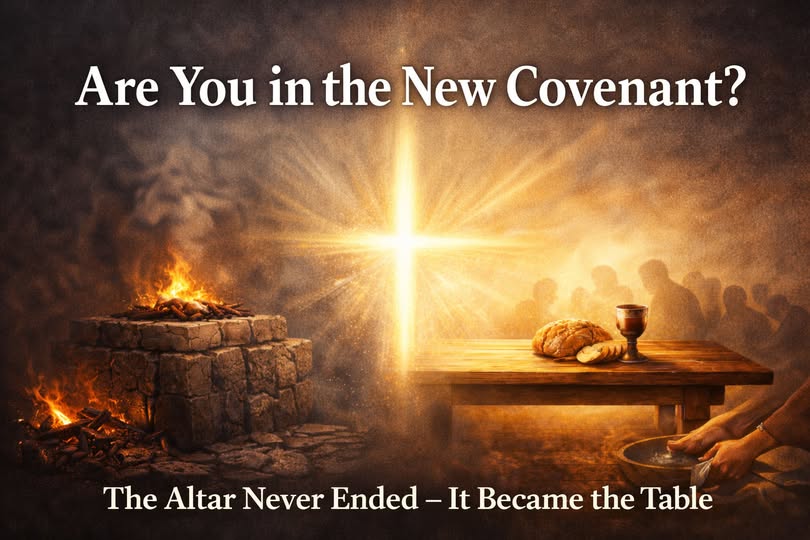
Most believers rarely think about the altar at all. When it *is* mentioned, it is often treated as something God used once and then discarded. Scripture shows a very different reality. The altar never disappeared — it reached its intended expression.
From the beginning, God provided a way to:
• Draw near to Him
• Hear His voice
• Experience His joy
• Receive cleansing
• Live from His provision
That way has always involved an altar — and from the start, the altar **pointed forward to the table**.
—
 **THE ALTAR WAS ALWAYS ABOUT COMMUNION, NOT RITUAL**
An altar was never merely a place of death. It was a place of *meeting*:
• God met Abraham at the altar
• God spoke to Moses from the tabernacle
• God accepted offerings rooted in trust
• God rejected offerings rooted in self
Abel’s offering was accepted because it trusted God’s provision.
Abraham raised the knife — but God supplied the sacrifice.
The altar existed so people could approach God on **His terms**, not their own. It was a doorway into communion, not a mechanism of self-effort.
—
 **THE OLD COVENANT ALTAR ESTABLISHED THE PATTERN**
Under the Law, the altar:
• Dealt with sin through sacrifice
• Required ceremonial washing
• Required discernment and obedience
• Ended in shared meals before God
Every acceptable sacrifice moved *toward fellowship*. Blood was shed, but the goal was restored relationship.
Scripture is clear about its limits:
> “It is not possible that the blood of bulls and goats should take away sins.” (Hebrews 10:4)
The altar functioned within its covenant — but it always pointed beyond itself.
—
 **THE CROSS FULFILLED THE ALTAR**
Jesus did not abolish the altar. He **fulfilled it**.
At the crucifixion:
• The true sacrifice was offered
• The veil was torn
• Access to the Father was opened
• Repeated bloodshed ceased
> “It is finished.” (John 19:30)
This did not remove communion with God — it removed the barriers that restricted it.
—
**THE TABLE CONTINUES THE ALTAR’S PURPOSE**
After the cross, Jesus did not instruct His disciples to build a stone altar. He gathered them at a **table**:
> “This is My body, given for you… This cup is the new covenant in My blood.” (Luke 22:19–20)
The table carries forward the altar’s purpose:
• The sacrifice is remembered
• The covenant is proclaimed
• Fellowship is shared
• Provision is received
Paul explains:
> “The cup of blessing… is it not the communion of the blood of Christ?” (1 Corinthians 10:16)
This is not repetition.
This is **participation**.
—
 **SCRIPTURE CALLS THE TABLE AN ALTAR**
> “We have an altar, whereof they have no right to eat which serve the tabernacle.” (Hebrews 13:10)
Christians have an altar you **eat from**.
Paul reinforces the point:
> “You cannot partake of the table of the Lord and the table of devils.” (1 Corinthians 10:21)
The comparison only works if the table functions as an altar.
—
### **THE ALTAR IN SCRIPTURE — NOW A TABLE**
The word “altar” in Scripture is rich with meaning, and understanding its etymology shows why the table is **not symbolic**, but the **continuation of the altar** in the New Covenant.
**Hebrew (Old Testament):**
* מִזְבֵּחַ (*mizbeach*) literally means “place of sacrifice” or “place of slaughter.”
* Rooted in the idea of **offering, covenant obedience, and approaching God**.
* The altar was **both functional and relational** — a structure for sacrifice, yes, but also the place where people met God, received His provision, and experienced fellowship.
**Greek (New Testament):**
* θυσιαστήριον (*thysiastērion*) literally means “place of sacrifice” or “thing offered.”
* While the Greek retains the sense of **a sacrificial place**, the context clarifies that this altar is **no longer a stone structure for animal offerings**. It is now a **table**, where believers partake in **Christ’s body and blood**, participating directly in His sacrifice.
**Key Insight:**
* This understanding bridges the Old and New Covenants: **the altar’s relational and covenantal purpose remains intact**, now fully expressed in the New Covenant table.
—
 **CLEANSING CONTINUES — BOTH OUTWARD AND INWARD**
Cleansing was not abolished. It was **retained and transformed**.
Under the Law:
• Washings prepared people to approach God
• External cleansing preceded sacrifice
• Contact with defilement required washing
Jesus continued this pattern:
> “He riseth from supper… and began to wash the disciples’ feet.” (John 13:4–5)
This was not symbolic theater.
> “If I wash thee not, thou hast no part with Me.” (John 13:8)
Symbols do not determine participation. **Actions do.**
—
 **FOOT WASHING IS NEW COVENANT CLEANSING**
Jesus clarified:
> “He that is washed needeth not save to wash his feet, but is clean every whit.” (John 13:10)
This shows:
• Full cleansing belongs to Christ
• Ongoing washing belongs to the body
• Fellowship requires both
Feet touch the ground, and the ground is still defiled. We walk among:
• Sin
• Deception
• Corruption
• Defiled systems and people
> “The whole world lieth in wickedness.” (1 John 5:19)
> “The god of this world hath blinded the minds…” (2 Corinthians 4:4)
Foot washing addresses **contact defilement**, not justification.
—
**WE WASH ONE ANOTHER BEFORE WE COME TO THE TABLE**
Jesus commanded:
> “Ye also ought to wash one another’s feet.” (John 13:14)
This is covenant maintenance. It:
• Removes offense
• Breaks pride
• Restores fellowship
• Prepares the body for communion
Paul presupposes this order:
> “Let a man examine himself…” (1 Corinthians 11:28–29)
Examination is not abstract introspection. It is **communal, embodied discernment**.
—
 **WHY THIS CANNOT BE SYMBOLIC**
If cleansing, crucifixion participation, or the table were merely symbolic:
• Obedience becomes optional
• Fellowship becomes theoretical
• Communion becomes ceremony
• The body loses its covenant responsibility
Here’s the key: **any effort we do on our own only glorifies ourselves**. When we attempt to follow God without **utilizing His provision** — His cleansing, His body, His table — it is **self-effort**, not covenant participation.
> True obedience **glorifies God** because it shows we are following His instructions and relying on His provision.
Fruit is produced — real, tangible transformation that others can see — not because of our actions, but because **He is working through us**. This is why the table, the foot washing, and the participation in the crucifixion **cannot be merely symbolic**. They are **visible manifestations of covenant obedience** and of Christ crucifying our flesh, and the effects are **noticeable to the body and the world**.
—
**WHAT DAILY PARTICIPATION LOOKS LIKE**
Daily participation involves:
• Entering into Christ’s death through faith
• Aligning with His life, not our own
• Receiving His cleansing in our hearts
• Submitting to the ongoing work of the Spirit
> “He that eateth My flesh, and drinketh My blood, dwelleth in Me, and I in him.” (John 6:56)
The table is the daily place where this happens.
It is here that Christ **crucifies our flesh**, purifies our hearts, and strengthens us to live from His life.
—
**THE TABLE SUSTAINS PARTICIPATION**
> “The bread which we break, is it not the communion of the body of Christ?” (1 Corinthians 10:16)
Through eating and drinking, we **receive the power of the crucifixion**, allowing Jesus to continue cleansing, renewing, and crucifying the flesh from the inside out.
“give us this day our daily bread…..”
Daily bread = daily participation in His death.
Daily life = daily reception of His resurrection.
—
 **THE MEGIDDO MOSAIC — AN EARLY CHURCH BUILT AROUND A TABLE**

Archaeology reinforces this truth. In ancient **Megiddo**, Israel, a richly decorated early Christian worship hall was discovered. Its central feature? **A table** — not a stone altar.
Greek inscriptions on the mosaic read:
> “**The god-loving Akeptous has offered the table to God Jesus Christ as a memorial.**”
This tells us:
1.  **The table was central, not peripheral.** It was the heart of their gathering.
2. **It was dedicated to Jesus Christ**, showing the table was sacred and meant for communion.
3.  **It was a personal gift**, reflecting the relational, participatory nature of early Christian life.
Long before grand church buildings existed, the early church was **taught from the beginning** to gather **around a table** to participate in the life, death, and resurrection of Christ — exactly what Scripture teaches.
—
 **THE LITTLE SEASON — COVENANT CUT OFF BY DESIGN**
When we look at history and Scripture together, it becomes **very clear that the world we live in today was designed with this in mind**.
The early church was **taught from the beginning** to gather **around a table**, wash each other’s feet, and share life intimately. This was covenant in action — **real, embodied participation in Christ**.
Modern systems — big buildings, massive gatherings, hierarchical structures — **make this impossible**:
• Foot washing is rarely practiced
• Agape love is diluted
• Direct covenant participation is blocked
Those who shaped this world understood what God had designed the early church to practice:
> When believers are **forced into large, impersonal systems**, real covenant life **cannot flourish**.
By separating the body from **practical, relational obedience**, the enemy **cut off covenant by design**.
This is the reality of the little season:
• Communion is minimized
• Participation in the crucifixion is abstracted
• True fellowship is disrupted
The altar — now perfectly embodied in the table — remains the **doorway to life**, but only for those willing to **enter covenant, wash one another, and participate in Christ’s death and resurrection** daily.
—
**CONCLUDING THOUGHT**
The altar never ended.
All the old altars pointed to the table.
The table sustains real fellowship.
The cross crucifies our flesh as we participate.
Foot washing cleanses our hearts.
And the Megiddo Mosaic reminds us that the early church was **taught from the beginning** to center their worship on the table.
**True covenant life is relational, participatory, and centered on the table — and the enemy has worked to disrupt it in every way possible. But the table remains, calling us back to Christ and to one another.**

This is another that is really important I believe.