

Church


Returning to the Simplicity
of the Early Church.
Before reading, take a moment to listen to “Made for the table in Satan’s little season.”
Join A Church
Not registered? Create an Account
Forgot your password? Reset Password
“And they continued stedfastly in the apostles’ doctrine and fellowship, and in breaking of bread, and in prayers.”
— Acts 2:42Returning to the Simplicity of the Early Church
Waymker is not built around creating another denomination, celebrity ministry, or institutional church system. Our desire is to help restore the kind of covenant-based Christian fellowship we believe existed in the early church:
- local
- relational
- accountable
- Spirit-led
- communion-centered
- family-oriented
- rooted in obedience to Jesus
We believe many modern churches have become centered around:
- weekly performances
- large institutional structures
- passive attendance
- branding
- entertainment
- personality-driven leadership
- financial dependence on centralized systems
The New Testament picture of church is very different. It says we’re supposed to be:
- much more personal
- participatory
- sacrificial
- interconnected
- unified
- Holy
- beneficial to others
- filled with the Spirit
We believe church was never meant to be something you “go to.”
We believe the church is a living body of believers walking together in covenant life.
The Church Is the People — Not the Building
In Scripture, believers primarily gathered:
- house to house
- around meals
- in fellowship
- in prayer
- in communion
- in mutual care
- in shared life
“And they, continuing daily with one accord… breaking bread from house to house…”
— Acts 2:46We believe this was not merely a temporary survival model for persecuted Christians. We believe it was the intended structure of Christian community life.
The early church functioned more like an extended spiritual family than a religious institution. People knew one another deeply. They shared burdens. They ate together. They prayed together. They corrected one another. They lived life together.
What We Believe Modern Church Often Gets Wrong
We believe much of modern Christianity has unintentionally replaced biblical church life with:
- spectator Christianity
- hierarchical leadership systems
- dependency on one teacher
- shallow fellowship
- religious programming
- emotional experiences without discipleship
- weekly attendance without shared life
In many churches: the congregation watches, one man performs, people leave anonymous, and little real discipleship occurs.
But Scripture describes something much more active and interconnected.
“That there should be no schism in the body; but that the members should have the same care one for another.”
— 1 Corinthians 12:25We believe believers are supposed to function together as an actual body.
What a Typical Waymker Gathering Looks Like
Most gatherings within Waymker are intended to happen in homes and small local settings.
This may look like:
- families gathering together
- believers sharing meals
- worship in living rooms
- prayer together
- reading and discussing Scripture
- communion around a table
- feet washing
- mutual encouragement
- confession and accountability
- helping one another practically
Rather than rows of spectators, stages, performances, and rigid productions, we believe gatherings should feel personal, participatory, and spiritually alive.
A gathering may include:
- open discussion
- teaching
- worship
- silence and prayer
- testimony
- Scripture reading
- meals together
- planning ways to help the local community
- checking on struggling members
- discipleship conversations
Children are present. Families are integrated. People participate rather than merely observe.
Communion Is Central — Not Occasional
We believe communion is not merely a symbolic church ritual. We believe it is covenant participation in the sacrifice, life, death and resurrection of Jesus Christ.
Modern Christianity has often reduced communion to:
- tiny crackers
- small cups
- brief ceremonies
- occasional rituals disconnected from real fellowship
But in Scripture, communion happened in the context of shared covenantal agape meals.
“For we being many are one bread, and one body.”
— 1 Corinthians 10:17We believe the agape meal reflects unity, sacrifice, covenant, remembrance, and shared identity in Christ.
Communion reminds believers:
- we belong to Jesus
- we belong to one another
- we are called to die to ourselves
- covenant life requires obedience and love
Because of this, shared meals are extremely important within Waymker gatherings.
Feet Washing and Humility
We believe feet washing was not meant to become a forgotten symbol. Jesus Himself washed the feet of His disciples and commanded them to do likewise.
“I have given you an example, that ye should do as I have done to you.”
— John 13:15Not only do we believe that foot washing is a ritual washing that was commanded by Jesus, we believe feet washing reflects humility, equality among believers, servant leadership, cleansing, and covenant love expressed physically.
The Kingdom of God is not built on pride, status, or power structures. It is built on service. We believe physically serving one another matters.
Eldership Within Waymker
We do not believe churches should revolve around one dominant personality or celebrity pastor. We believe biblical leadership is local, relational, accountable, plural, servant-oriented and held to the highest of standards.
In Scripture, churches were typically overseen by multiple elders rather than one central personality.
The role of elders is not:
- self-exaltation
- financial gain
- fame
- control
- corporate leadership
- spiritual domination
The role of elders is to:
- shepherd the flock
- protect doctrine
- care for people
- resolve conflict
- model Christlike living
- equip believers
- serve the body
“Feed the flock of God which is among you… neither as being lords over God’s heritage.”
— 1–3We believe leadership should be deeply involved in people’s actual lives rather than functioning primarily as distant platform communicators.
Accountability and Holiness
We believe biblical community requires real accountability. Not control. Not manipulation. Not abuse. But loving accountability rooted in covenant relationship.
Modern society often teaches radical individualism (“my truth”, “my life”, “private spirituality”). But Scripture describes believers as responsible to one another.
We believe Christians should:
- encourage one another
- correct one another
- confess struggles
- help restore one another gently
- carry burdens together
- pursue holiness together
“Exhort one another daily…”
— Hebrews 3:13Real church life means people actually know each other.
Men, Women, and Leadership Roles
We believe men and women are equally valuable before God and both are vital to the life of the church.
Women:
- serve
- teach in many contexts
- disciple
- minister
- pray
- encourage
- help lead through wisdom and service
However, we believe Scripture reserves eldership, shepherding authority, and doctrinal oversight within the gathered assembly to qualified men.
We understand this is controversial in modern culture, but we seek to follow what we believe Scripture teaches rather than reshaping doctrine around cultural expectations. We believe leadership is responsibility and service — not superiority.
Gathering Regionally and Corporately
While home gatherings are central, we also believe there is value in larger regional fellowship gatherings.
From time to time, local groups may gather together regionally for:
- worship
- fellowship
- teaching
- communion
- prayer
- outreach
- baptisms
- support coordination
- helping the broader body stay unified
These gatherings may resemble a larger church assembly at times. However, we do not believe large gatherings should replace local covenant life in homes and communities. The primary life of the church should remain local and relational.
Church Throughout the Week — Not Just Sunday
We do not believe church should function as a once-a-week event. The early believers shared life continually.
Waymker communities are intended to function throughout the week through:
- meals
- prayer
- helping one another
- discipleship
- communication
- practical service
- local outreach
- fellowship gatherings
Many groups may gather multiple times weekly in homes or community spaces. Church is meant to become part of everyday life.
The Role of the Platform
Waymker itself is not “the church.”
The platform exists to help facilitate:
- connection
- communication
- accountability
- local gatherings
- support systems
- discipleship
- regional and national coordination
- emergency response
- community building
The goal is to help believers reconnect locally and function together as a true body rather than isolated individuals.
A Different Vision of Church
We believe church should look less like:
- a corporation
- a concert
- a seminar
- a business
- a weekly performance
And more like:
- a covenant family
- a body
- a shared table
- a community
- a people walking together in obedience to Jesus
Our Hope
We are not claiming perfection. We are not claiming to recreate the first century perfectly.
But we believe the modern church desperately needs:
- restoration
- simplicity
- repentance
- fellowship
- accountability
- communion-centered life
- humility
- Spirit-led unity
And we believe Jesus is calling His people back to those things. Back to our first love.
“And they continued stedfastly in the apostles’ doctrine and fellowship, and in breaking of bread, and in prayers.”
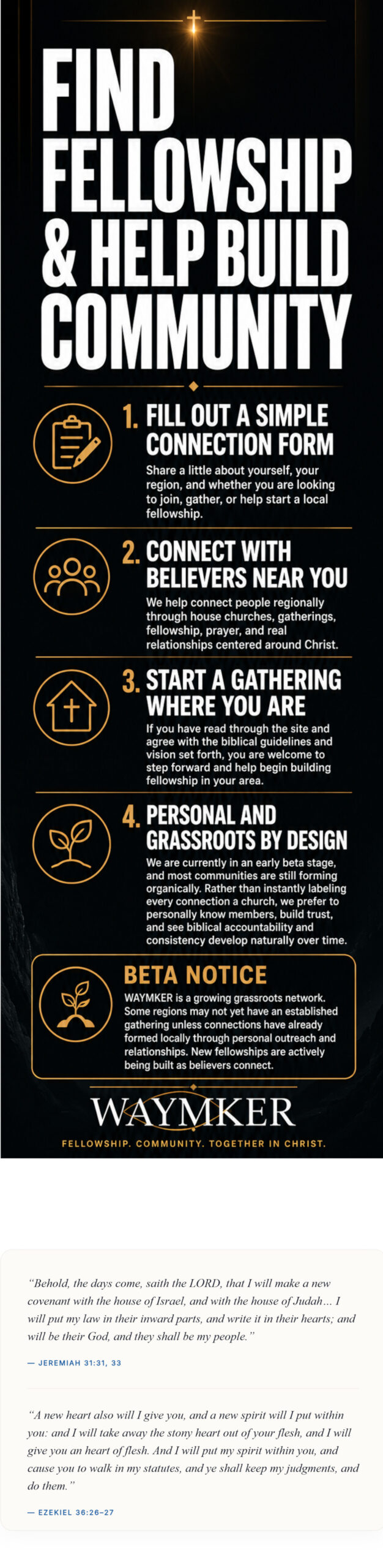
— Acts 2:42How to engage with Waymker.
Find a Gathering
Discover local believers and house church networks near you seeking biblical community.
Join the Platform
Create your free account to access forums, groups, mapping, and the Help Desk.
Request Prayer
If you are in a crisis or need support, the body of Christ is here to stand with you.
“The harvest is plentiful,
but the workers are few.”
Join the Dispatch
Weekly stories of God at work. No fluff, just encouragement.
Not registered? Create an Account
Forgot your password? Reset Password